Reform Movement Joint Statement on Death Penalty for Terrorists Law Passed by the Knesset

March 31, 2026

The Reform Movement strongly condemns the Knesset’s passage of the “Death Penalty for Terrorists Law.” This legislation represents a sharp and dangerous departure from Israel’s long-standing reluctance to employ capital punishment, used only in the most extraordinary circumstances in the state’s history. It also contradicts the Jewish tradition’s teachings about capital punishment that emphasize the rarity with which it should be applied.

We recognize, unequivocally, Israel’s right and obligation to defend its citizens from terror and violence. We mourn all those who have suffered devastating loss through the many terrorist attacks Israelis have suffered. At the same time, we affirm that the pursuit of justice must never abandon the core values that define a democratic and Jewish state.

Jewish tradition is unambiguous in its insistence on equal justice under the law:
 “תּוֹרָה אַחַת יִהְיֶה לָאֶזְרָח וְלַגֵּר” — “There shall be one law for the citizen and for the stranger” (Exodus 12:49). Any system of justice that is applied unevenly—whether in law or in practice— as this new law effectively does, undermines both democracy and Torah. It also raises legitimate questions of racism: As many have noted, the law’s provisions are such that Baruch Goldstein, the 1994 notorious, Jewish murderer of 29 Palestinians at prayer, would all but certainly not have been held to account under this law’s terms. And in this moment when Jewish extremists are acting with greater violence against Palestinians, typically with little or no accountability, this law further shames Israel’s justice system. Moreover, this legislation appears to be driven not by legitimate security needs but by political considerations. Security professionals have long questioned the deterrent value of capital punishment in cases of terrorism, and many argue that such measures risk inflaming tensions rather than enhancing safety. We are also horrified that some proponents of this law have chosen to wear noose pins on their lapels—a symbol that reflects a spirit of retribution rather than justice, and one that diminishes the moral seriousness required in matters of life and death.

The Reform Movement has long opposed the use of the death penalty. Rooted in our understanding of Torah and rabbinic tradition, we affirm the inherent dignity of every human being and the fallibility of any human system of judgment. The rabbis of the Talmud so constrained the use of capital punishment that they effectively rendered it nearly impossible to carry out, teaching that a court that executes even rarely is to be regarded with grave concern.

At a time of profound pain and fear, it is precisely our deepest values that must guide us. Policies of irreversible punishment risk further erosion of moral authority, escalation of violence, and damage to Israel’s democratic character and global standing.

We urge Israel’s leaders to reconsider this legislation, to uphold the principles of equal justice, and to pursue policies that ensure security while preserving the moral and democratic foundations of the State of Israel.

Union for Reform Judaism
Shelley Niceley Groff, Chair(she/her)
Rabbi Rick Jacobs, President(he/him)

Central Conference of American Rabbis
Rabbi David Lyon, President (he/him)
Rabbi Hara Person, Chief Executive (she/hers)

American Conference of Cantors
Cantor Josh Breitzer, President (he/him)
Rachel Roth, Chief Executive Officer (she/her)

CCAR statements are grounded in the history of CCAR resolutions and platforms. We strive to represent the overall voice of the CCAR leadership and the Reform rabbinate on critical issues of the day. The CCAR is a diverse community of rabbis, and we recognize the multiplicity of viewpoints that exist within our membership. We encourage those of differing perspectives to engage in respectful dialogue. It is our hope that these statements provide the Reform community with deeper understanding of important issues that impact our lives as Jews and as global citizens.
Back to CCAR Statements

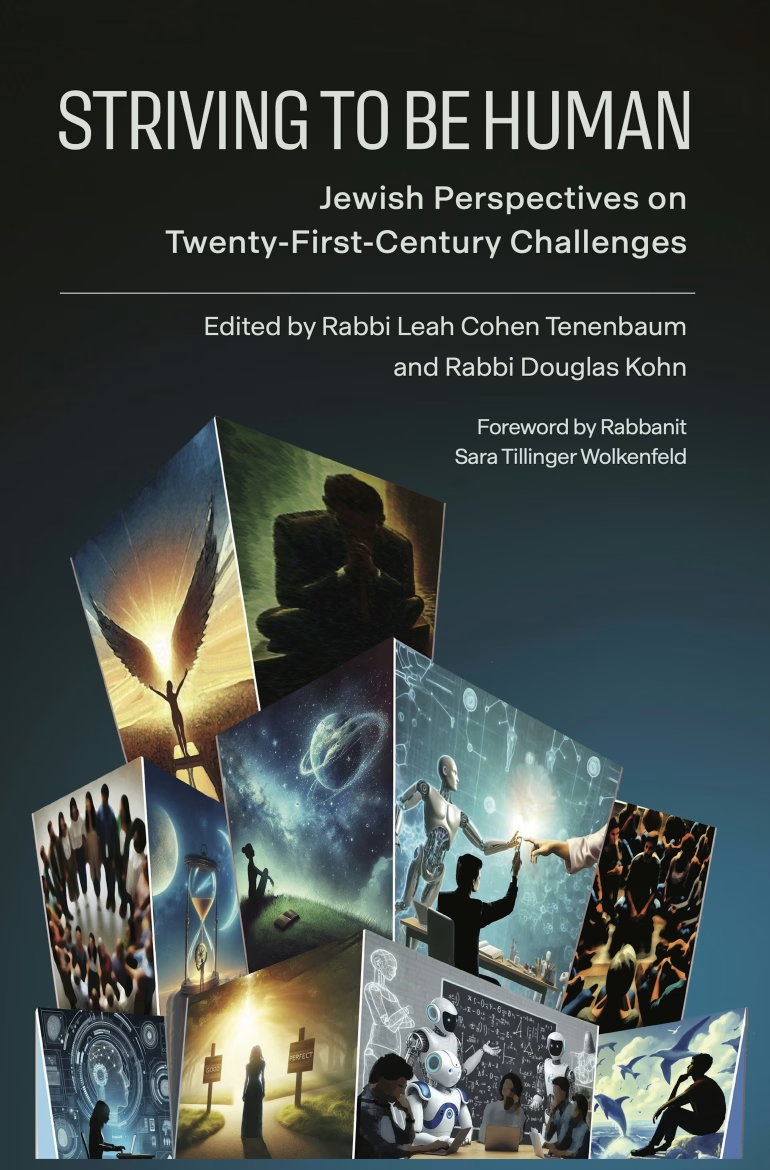
CCAR PRESS ANNOUNCES RELEASE OF ‘STRIVING TO BE HUMAN: JEWISH PERSPECTIVES ON TWENTY-FIRST-CENTURY CHALLENGES’

New book offers contemporary Jewish perspectives on artificial intelligence, reproductive technology, animal rights, and more—and their ethical and spiritual significance.

New York, NY – December 2025 – CCAR Press, a division of the Central Conference of American Rabbis, proudly announces the publication of Striving to Be Human: Jewish Perspectives on Twenty-First-Century Challenges, edited by Rabbi Leah Cohen Tenenbaum and Rabbi Douglas Kohn.

Each day, new technological innovations spark fierce debates between promise and peril. Striving to Be Human offers Jewish wisdom to help navigate these existential divides. In his clarion call for ethical behavior, Rabbi Hillel tell us, “In a place where there is no humanity, strive to be human.” But what exactly does it mean to be human in this age of rapid transformation? Striving to Be Human confronts the age-old, ever-evolving question of humanity with boldness, hope, and a foundation in Jewish texts.

Striving to Be Human begins with “Challenges from Within Us,” addressing topics including moral justice, belonging, queer theology, and good and evil. In part two, “Challenges from Beyond Us,” the authors delve into artificial intelligence, robotics, reproductive technologies, and the animal-human relationship. The result is a profound conversation about Jewish values and human dignity in our evolving landscape.

Hava Tirosh-Samuelson, PhD, Irving and Miriam Lowe Professor of Modern Judaism, Arizona State University, and coeditor of Perfecting Human Futures: Transhuman Visions and Technological Imaginations, said, “This timely collection of thoughtful reflections by Reform rabbis invites readers to examine the meaning of being human when the future of humanity is challenged by the prevalence of humanmade technology, and when the future of democracy is threatened by the refusal to honor intrinsic human dignity and diversity. Rabbis, educators, and congregants will find this anthology a source of inspiration and an invitation for further reflections.”

“One of the most fundamental inquiries in Jewish philosophy is what makes humans different from animals, on the one hand, and from angels, on the other,” said Rabbi Dr. Shmuly Yanklowitz, President and Dean of Valley Beit Midrash and author of Pirkei Avot: A Social Justice Commentary. “In our era of rapid change, Striving to Be Human masterfully helps us return to such questions to not only reclaim our basic humanity but to consider how to actualize the potential of flourishing humanity! This book will guide us toward moral and spiritual insights that can challenge and support our theological and ethical journeys ahead.”

Jonathan D. Sarna, PhD, Joseph H. and Belle R. Braun Professor of American Jewish History, Brandeis University, and author of American Judaism: A History, said, “At a time of unprecedented challenges to humanity, this volume offers Jewish wisdom on the core question: What does it mean to be human? A thoughtful, readable, and well-produced guide to conundrums as ancient as Adam and Eve and as recent as the development of artificial intelligence.”

Rabbi Leah Cohen Tenenbaum, DMin, BCC-PCHAC, is a Board-Certified Chaplain with Advanced Certification in Hospice and Palliative Medicine at Yale New Haven Hospital where she also serves on the Ethics Committee, teaches medical providers, and presents at national conferences on spirituality, serious illness, and medical ethics.

Rabbi Douglas Kohn has led historic Temple Beth Jacob in Newburgh, New York, since 2019, having previously served synagogues in Buffalo, Baltimore, Chicago, and Southern California. Deeply committed to social justice and Israel, Rabbi Kohn served for eight years on the Commission on Social Action of Reform Judaism and the National Board of ARZA.

Striving to Be Human: Jewish Perspectives on Twenty-First-Century Challenges is available at strivingtobehuman.ccarpress.org.

To request review copies, interview opportunities, or to book author events, please contact: Raquel Fairweather-Gallie, Marketing and Sales Manager, CCAR Press: rfairweather@ccarnet.org.

Back to CCAR In the News

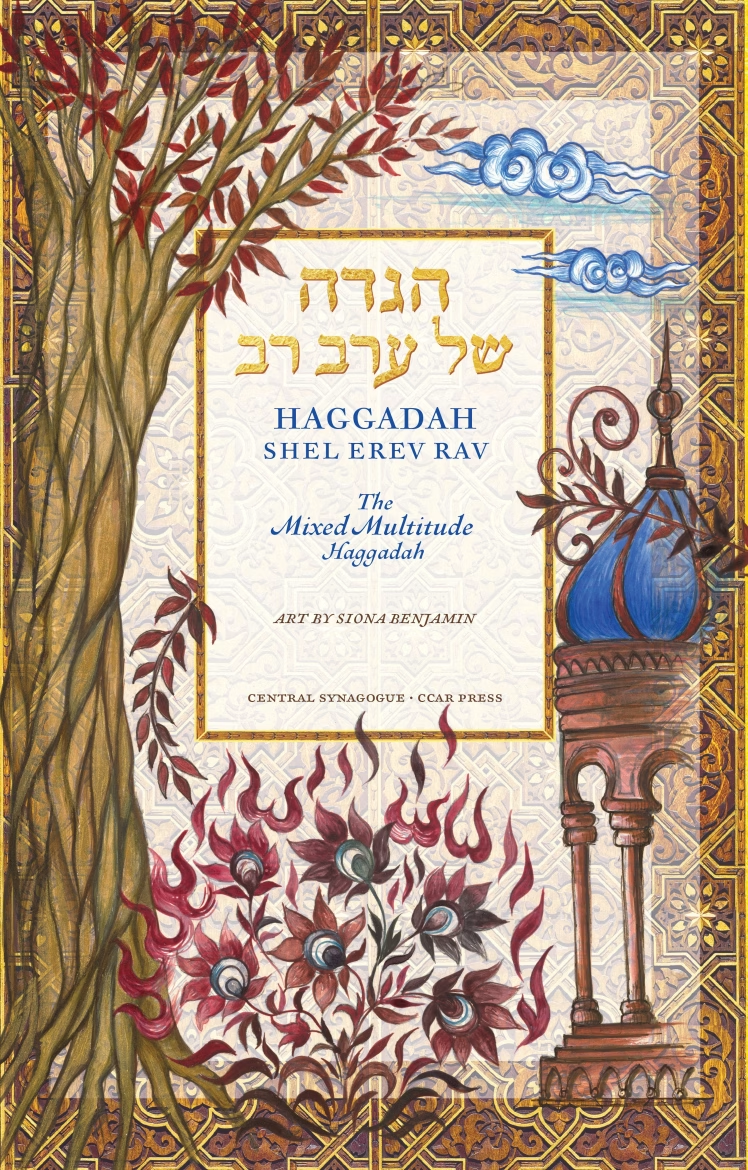
CCAR PRESS AND CENTRAL SYNAGOGUE ANNOUNCE RELEASE OF ‘HAGGADAH SHEL EREV: THE MIXED MULTITUDE HAGGADAH’

Published in honor of Rabbi Angela W. Buchdahl’s twenty years at Central Synagogue, this striking new Passover Haggadah provides various pathways for people of all backgrounds to connect to the ancient story of liberation, along with colorful art by Siona Benjamin.

New York, NY – March 2026 – CCAR Press, a division of the Central Conference of American Rabbis, in partnership with Central Synagogue, proudly announces the publication of Haggadah Shel Erev Rav: The Mixed Multitude Haggadah, edited by Rabbi Sarah Berman. The Haggadah is published in honor of Rabbi Angela W. Buchdahl’s twenty-year anniversary at Central Synagogue.

The Passover story of the Jewish journey from oppression to liberation is told throughout the world, with each seder table bringing its own customs based on countries of origin, family traditions, and contemporary additions. As Rabbi Buchdahl notes in the Haggadah’s preface, “this multiplicity is not a modern invention— it has been with us since the Exodus itself. The Torah tells us that when we fled Egypt, we did so as an erev rav, a “mixed multitude”—a diverse assembly of Israelites and fellow travelers, all swept up in a shared yearning for freedom. From our very beginning, we were not a monolith but a mosaic.” This new Haggadah elevates and celebrates the mosaic that is Judaism today.

Mixing lyrical translations of the Haggadah text by Rabbi Janet Marder and Rabbi Sheldon Marder, vibrant artwork by Indian Jewish artist Siona Benjamin, and original commentary by the clergy of New York City’s Central Synagogue, Haggadah Shel Erev Rav centers the myriad ways Jews engage with this ancient story. Four different choices for the Magid (“Telling”) section allow participants to decide how to engage with the Passover story—through the lens of young people, liberation, feminism, or Divine action. A special section provides suggestions for using the book with children, and a thorough introduction explains the beauty and nuance of the original art.

The theme of the Haggadah is the holiness of the erev rav, the “mixed multitude.” As Rabbi Buchdahl—one of the world’s most prominent rabbinic voices—notes, “this theme is not just embedded in our ancient story; it is a reflection of how we strive to live as a community.” Indeed, this new Haggadah—with its connection to history, its commitment to inclusion, and its vibrancy and aliveness—is itself a beautiful reflection of Jewish community of the past, present, and future.

Rabbi Angela W. Buchdahl is the first Asian American to be ordained as a rabbi or cantor in North America. She joined Central Synagogue in 2006 and has served as Senior Rabbi since 2014. Her 2025 memoir Heart of a Stranger: An Unlikely Rabbi’s Story of Faith, Identity, and Belonging was an instant New York Times Bestseller.

Rabbi Sarah Berman is Director of Jewish Culture and Programming at Central Synagogue. Prior to her ordination, she worked for more than a decade at the Seattle Art Museum in curatorial and research roles. Both Rabbi Buchdahl and Rabbi Berman are members of the Central Conference of American Rabbis.

Siona Benjamin is a Bene Israel Jewish artist who was raised in Mumbai and now lives in the United States. She holds MFAs in painting and theatrical set design, and was awarded Fulbrights to India and Israel. Her work has been exhibited in the United States, Europe, and Asia, and she has been praised by the New York Times, Boston Globe, Financial Times, and Times of India.

Haggadah Shel Erev Rav: The Mixed Multitude Haggadah is available at erevrav.ccarpress.org.

To request review copies, interview opportunities, or to book author events, please contact: Raquel Fairweather-Gallie, Marketing and Sales Manager, CCAR Press: rfairweather@ccarnet.org.

Back to CCAR In the News

400 Reform Rabbis Gather in San Francisco Bay Area for Central Conference of American Rabbis’ Annual Conference

Rooted in the Bay Area’s history of justice, the CCAR convenes to confront challenges, share voices from the global Reform Movement, and engage in Torah study, rabbinic renewal, and deep dialogue about leading Reform Judaism with hope.

March 15, 2026, San Francisco, CA: The Central Conference of American Rabbis (CCAR)—the Reform rabbinical professional association—is convening four hundred Reform rabbis from across North America and across six continents in the San Francisco Bay Area this week for their 137th annual rabbinic Convention for four days of Torah study, professional development, engaged learning, deep dialogue, and immersive programming.

At a moment when American Jewish communities are navigating profound challenges—from rising antisemitism to deepening political polarization—Convention programming features distinguished Jewish thought leaders addressing the most pressing issues of our time. Historian and scholar Pamela Nadell will address the rabbinate in a session entitled “Antisemitism, An American Tradition,” also the title of her widely acclaimed recent book. Aaron Dorfman, Executive Director of A More Perfect Union: The Jewish Partnership for Democracy, will lead a critical conversation on democracy and the American Jewish community. Dr. Marc Dollinger, Chair of the Department of Jewish Studies at San Francisco State University and author of Black Power, Jewish Politics: Reinventing the Alliance in the 1960s, will explore the changing landscape of Jewish identity. 

The Convention will also amplify significant voices from the Israeli Reform Movement, including Israeli Reform Rabbis Efrat Rotem, Binyamin Minich and Yael Vurgan, who will lead the Convention in prayer and share Israeli perspectives on Reform Judaism and liberal Jewish values, and what the post-October 7 Jewish future might look like in America and Israel.

Bay Area rabbis will play a central role throughout the Convention, bringing the region’s rich Jewish and social justice history to life. Rabbi Michael Lezak of GLIDE in San Francisco will lead an immersive tour of GLIDE’s transformative work connecting Reform Judaism’s commitment to justice and inclusivity with on-the-ground community impact.

Rabbi Yoel Kahn, who shepherded Congregation Sha’ar Zahav through the height of the AIDS epidemic, and current Sha’ar Zahav leader Rabbi Mychal Copeland, will lead a walking tour of LGBTQ+ San Francisco’s Jewish past and present, a testament to Reform Judaism’s enduring commitment to inclusion and human dignity. Rabbi Cassi Kail, Director of Jewish Life and University Chaplain at Chapman University, co-leads the Convention’s organizing committee. CCAR Board Member and Senior Rabbi of Oakland’s Temple Sinai, Rabbi Jackie Mates-Muchin, will also play a prominent role.

San Francisco’s historic Congregation Emanu-El will serve as a key Convention destination, with Rabbis Ryan Bauer, Sarah Joselow Parris, Madeline Budman, and Sydney Mintz participating in programming. Rabbi Jonathan Aaron and Cantor Lizzie Weiss of Los Angeles will lead the Convention’s central prayer service. Congregation Emanu-El’s Rabbi Emeritus Jonathan Singer also played an instrumental role in preparation for the Convention.

“City-as-text” offsite experiences will include a visit to City Hope, a community center, restaurant, and sober-living facility in the Tenderloin led by founder Rev. Paul Trudeau; City Hope shares a meaningful partnership with Congregation Emanu-El’s teen program. Additional excursions include a behind-the-scenes preview of the upcoming Courage Museum, a visit to Urban Adamah (an educational farm and community center in Berkeley), and explorations of the intersection between San Francisco’s storied social justice landscape and the values of Reform Judaism.

The CCAR will also honor members celebrating their fiftieth anniversary of their ordination.

“This is no easy time to be a rabbi. In addition to leading congregations and communities through deepening uncertainty and polarization, rabbis are spiritual first responders—continually leading from crisis to crisis, giving to their communities, even when their own spiritual well has run dry. Our annual gathering is a way for the CCAR to give back to rabbis: to nourish them with the strength of their rabbinic community, to provide them with the tools to navigate ongoing  uncertainty, and most importantly, to build resilience and reinvigorate them with hope and clarity as we reimagine our sacred work together.” —Rabbi Hara Person, Chief Executive, Central Conference of American Rabbis.

___

The Central Conference of American Rabbis (CCAR) is the Reform Rabbinic leadership and professional association. The CCAR strengthens the Jewish community by providing religious, spiritual, ethical and intellectual leadership and wisdom. CCAR and its members lead the Reform Movement on important spiritual, social, cultural and human rights issues, as it has done since 1889. The CCAR is also the center for lifelong rabbinic learning, professional development, and resources for the more than 2,100 rabbis who serve more than 2 million Reform Jews throughout North America, Israel, and the world. Since its founding, the CCAR has also served as the primary publisher of the Reform Movement through CCAR Press and its imprint Reform Judaism Publishing.

Contact: Tamar Anitai, CCAR Director of Strategic Communications, tanitai@ccarnet.org

Back to CCAR In the News

The Reform Jewish Quarterly Winter 2026

CCAR Journal: The Reform Jewish Quarterly

Published by the Central Conference of American Rabbis

Order the issue

From the Editor

Articles

  • The Golem as Theology: The Mutable Myth Confronting the Problem of Evil — Rabbi Stanley M. Davids, z”l, with Rabbi Tamara Cohn Eskenazi, PhD, and Joshua Glucksman
  • Studying American Scripture and Healing Civic Health — Rabbi Michael G. Holzman and Rabbi Jessie Wainer
  • Hebrew Union College’s New Rabbinical School Curriculum: Integrative Rabbinical Education for A New Generation — Rabbi Joseph A. Skloot, PhD, and Rabbi Dvora E. Weisberg, PhD
  • Kitab al-Dhimma: A Jewish Counter-History — Rabbi Reuven Firestone, PhD

Book Reviews

  • Christmas in Yiddish Tradition: The Untold Story by Jordan Chad — Reviewed by Rabbi Stacy Petersohn
  • Mother Emanuel: Two Centuries of Race, Resistance, and Forgiveness in One Charleston Church by Kevin Sack — Review by Rabbi Stephanie M. Alexander
  • The Last Generation of the German Rabbinate: German Refugee Rabbis in the United States, 1933–2010 by Cornelia Wilhelm — Reviewed by Rabbi Ari S. Lorge
  • The Sacred Struggle: Jewish Responses to Trauma, edited by Rabbi Lindsey Danziger and Rabbi Benjamin David — Reviewed by Rabbi Julie Pelc Adler
  • To Be a Jew Today: A New Guide to God, Israel, and the Jewish People by Noah Feldman – Reviewed by Rabbi Dr. Israel Bobrov Zoberman

Poetry

  • Like Isaac — Rabbi Dr. Israel Bobrov Zoberman
  • Avatiach — Roger Nash, PhD
  • A Niggun — Roger Nash, PhD
  • Stolperstein — Roger Nash, PhD
  • Parochet — Roger Nash, PhD
  • Neshamah — Eva Alter
  • Noah’s Ark — Rabbi Marc J. Belgrad

Responsum 5784.3

  • Burial of a Person in a Pet Cemetery — CCAR Responsa Committee, Rabbi Joan Friedman, PhD, chair

Maayanot (Primary Sources)

  • The Preface to Jacob Sasportas’s Tol’dot Yaakov — Introduction and Translation by Rabbi Laurence L. Edwards, PhD

Subscriptions and Ordering 

Back issues are available at $35 per issue plus shipping. To order copies of the CCAR Journal, please visit ccarpress.org.

To subscribe, please email CCAR Press at info@ccarpress.org.

Central Conference of American Rabbis Grieves the Death of Rabbi Andrea L. Weiss, PhD, ז״ל

March 4, 2026

The Central Conference of American Rabbis is in mourning in the wake of the tragic and untimely death of our teacher, our colleague, and our friend, Rabbi Andrea L. Weiss, PhD, ז״ל. A prolific scholar whose life and learning were her students’ greatest texts, Rabbi Dr. Weiss shaped a generation of Reform rabbis as Professor of Bible at Hebrew Union College in New York. She would go on to assume a transformative and pioneering leadership role, becoming the first woman to ordain rabbis and cantors at our Reform Movement’s flagship seminary. As Provost, Head of Seminary Programs, and Rabbinical School Director, Rabbi Dr. Weiss guided rabbinical education into a new era with creativity and rigor.

With the Women of Reform Judaism, Rabbi Tamara Cohn Eskenazi, PhD, and URJ Press under the leadership of Rabbi Hara Person, Rabbi Dr. Weiss oversaw a mammoth project that became a significant contribution to the Jewish canon: The Torah: A Women’s Commentary (CCAR Press, 2008), winner of the National Jewish Book Council’s 2008 Jewish Book of the Year Award. Later, she marshaled scholarship and relationships to speak to divisive moments in American life with two volumes of American Values, Religious Voices.

Reform rabbis will miss Rabbi Dr. Weiss’s menschlichkeit, brilliance, compassion, wisdom, integrity, eagerness to learn, and so much more. A rabbi’s rabbi, she was a generous teacher, mentor, and friend who truly loved her students and was invested in their successes. The loss to our Reform Movement is enormous. The grief of those who were ordained by her and of her faculty and staff colleagues is tremendous.

Andrea’s CCAR family extends deepest sympathy to her beloved husband Alan Tauber, to their children Rebecca and Ilan, to her father Marty Weiss; to her siblings Mitch, Laura, and Robert (Catherine Corrigan), and to her wide circle of friends and colleagues.

The memory of Rabbi Andrea L. Weiss, PhD, ז״ל, will always be a blessing.

Rabbi David A. Lyon, President
Rabbi Hara E. Person, Chief Executive
Central Conference of American Rabbis

A Personal Note from Rabbi Hara Person

If you are lucky, you may encounter someone who winds up impacting you in ways that are unimaginable in the moment. Rabbi Dr. Andrea Weiss was one such person for me. Andrea was invited in by Rabbi Dr. Tamara Eskenazi to work on The Torah: A Women’s Commentary, a project I had the privilege to oversee. Andrea, then a young scholar who did not yet have tenure, came in first as the Assistant Editor, and then ultimately became the Associate Editor. Through that long and often involved process of creating the book, Andrea became a dear friend and colleague. I came to admire her tenacity, her incredible drive, her high level of organization and astonishing attention to detail, and her subtle sense of humor. It was a huge honor to work with Andrea and Tamara, and the sense of pride and accomplishment we all felt when the book was not just done, but lauded and celebrated, was tremendous. The book was the initial glue that connected us, but our relationship as personal friends and professional colleagues continued on as we moved through our careers, both becoming “firsts” as women in our fields, figuring out how to balance parenting with professional responsibilities, and sharing our successes and challenges. Like so many in our rabbinic community and beyond, I will deeply miss my friend and colleague Rabbi Dr. Andrea Weiss, and am profoundly grateful for all the ways that she generously shared her bountiful gifts with us.

Back to CCAR Statements

Central Conference of American Rabbis Statement in Time of War

March 2, 2026

The Central Conference of American Rabbis stands with the people of Israel, under attack from Iran and its allies in response to the Israeli-American attack on the oppressive Iranian regime and its nuclear threat. Apartments, synagogues, and shelters have been hit, leading to loss of life and injury. Reform rabbis grieve each death and pray that the injured will be blessed with רפואה שלימה (r’fuah shleimah, complete healing). We are in awe of the efforts of Israeli civil society to assure that Israelis care for one another at this trying time.

Since Shabbat morning, Israelis have repeatedly rushed to their shelters and safe rooms, seeking safety. Missile, rocket, and drone attacks do not distinguish between combatants and civilians or between Jews and Palestinians. Everyone in Israel and the West Bank is living under mortal threat. We are particularly concerned for the welfare of Bedouin citizens living in villages not recognized by the government and Palestinians in the West Bank who lack the security offered by bomb shelters.

The hearts of CCAR members outside of Israel are united with those of our Israeli colleagues, Reform rabbis who are members of both the CCAR and MARAM, the Council of Israeli Reform Rabbis, and members of the communities they serve throughout the IMPJ and beyond. Whether seeking shelter or serving in the Israel Defense Forces, our Israeli colleagues are also providing pastoral care to their communities at a terrifying time. Our thoughts turn toward our future rabbinic and cantorial colleagues who are students in the Year-in-Israel program at Hebrew Union College in Jerusalem and of their family members abroad, including CCAR members, who pray for their safety from afar. Our hearts turn, too, to the safety of the American servicepeople involved in this action and the families who await their safe return, as well as to the well-being of all the innocent Iranians.

We pray that the time will soon come when the prophecy is fulfilled:

וכתתו חרבתיהם לאתים וחניתתיהם למזמרות

לא-ישא גוי אל-גוי חרב ולא-ילמדו עוד מלחמה.

וישבו איש תחת גפנו ותחת תאנתו ואין מחריד.

And they shall beat their swords into plowshares and their spears into pruning hooks.

Nation shall not take up sword against nation; They shall never again know war; but every family shall sit under its own vine and fig tree, with no one to make them afraid” (Micah 4:4).

Rabbi David A. Lyon, President
Rabbi Hara E. Person, Chief Executive
Central Conference of American Rabbis

CCAR statements are grounded in the history of CCAR resolutions and platforms. We strive to represent the overall voice of the CCAR leadership and the Reform rabbinate on critical issues of the day. The CCAR is a diverse community of rabbis, and we recognize the multiplicity of viewpoints that exist within our membership. We encourage those of differing perspectives to engage in respectful dialogue. It is our hope that these statements provide the Reform community with deeper understanding of important issues that impact our lives as Jews and as global citizens.
Back to CCAR Statements

Reform Movement Statement on War Against Iran

Sunday, March 1

At this perilous moment as the U.S. and Israel are at war against Iran, we stand in solidarity with our Israeli siblings—including soldiers of the IDF—American service members, and all innocent civilians throughout the region who are in harm’s way, including the brave Iranians who have taken to the streets to demand freedom from a tyrannical regime. There are many questions about the lead-up to this war and the way the U.S. Congress has been prevented from fulfilling its constitutional role in making the decision to wage it. And yet, there can be little doubt that Iran has been a malign force against its own people and against Israel, America, the global Jewish people, and so many others in the region and beyond.

Despite international pressure and a devastating attack last summer by Israel and the U.S., Iran continues to foment global violence and instability and, by many accounts, pursue ever-greater nuclear capabilities. Now, for the second time in eight months, the U.S. and Israel are acting with military force to address the threats posed by this dangerous and oppressive regime.

The time is past due for Iran to halt decades of violent, worldwide provocations and aggression—including the threat of nuclear weapons development. And, like countless others within Iran and beyond, we dream of an end to the repression that has kept Iranians from living freely for more than four decades. We were inspired by the resistance shown by Iranians in recent months and deeply pained by the regime’s violent response that took the lives of an unknown number of protestors—likely many tens of thousands.

We had deeply hoped that conflicts between the U.S. and Iran would have been resolved diplomatically. We also have serious concerns about the Administration’s lack of full engagement with Congress in launching this war. Across the highest levels of military, diplomatic, and defense circles, many are questioning whether we have a clear, thought-out strategy to ensure our military power achieves our intended goals. 

Many in our congregations, the Jewish community, and the broader American public want to see regime change to support the people of Iran, eliminate threats to security, and enhance regional stability. While they may recognize that war is not the remedy for every conflict, they believe a case can be made that military force is justified in this moment, and are both deeply concerned about and committed to a successful outcome to the approach that has been taken.  

This war has already led to loss of life among innocents in Iran and Israel alike. We are especially pained by the deaths and injuries within Israel as a result of Iranian missiles which have landed in the last day. We are praying for healing for all those who are wounded and comfort for the bereaved. And we are keeping in our hearts those in the direct line of Iranian missiles who are forced to seek safety in bomb shelters—as well as Palestinians who do not have access to shelters—at this very moment.

We urge U.S. leaders, including President Trump and Pentagon officials, to act with the utmost care in ensuring that this military operation is undertaken with minimal harm to innocent Iranian civilians, and call on the President to maintain clarity on the goals of this war and what achievements will mark its end. We also strongly support congressional oversight of any war to maintain the checks and balances that are the hallmark of our system of government.

We do not know how or when this war will end. Until that day, we look to the ancient words of our tradition:

Ufros aleinu sukkat shlomecha—And spread over us the shelter of Your peace.

Baruch atah Adonai shomer amo Yisrael v’kol yoshvei teivel la’ad—Blessed are You, Adonai, who watches over Your people Israel, and all Your children everywhere, forever.

Union for Reform Judaism
Rabbi Rick Jacobs (he/him), President
Shelley Niceley Groff (she/her), Chair

Central Conference of American Rabbis
Rabbi David Lyon (he/him), President
Rabbi Hara Person (she/hers), Chief Executive

American Conference of Cantors
Cantor Josh Breitzer (he/him), President
Rachel Roth (she/her), Chief Executive Officer

Men of Reform Judaism
Larry Pepper (he/him), President
Steven Portnoy (he/him), Executive Director

Women of Reform Judaism  
Karen Sim (she/her), President 
Rabbi Liz P. G. Hirsch (she/her), CEO

CCAR statements are grounded in the history of CCAR resolutions and platforms. We strive to represent the overall voice of the CCAR leadership and the Reform rabbinate on critical issues of the day. The CCAR is a diverse community of rabbis, and we recognize the multiplicity of viewpoints that exist within our membership. We encourage those of differing perspectives to engage in respectful dialogue. It is our hope that these statements provide the Reform community with deeper understanding of important issues that impact our lives as Jews and as global citizens.

Back to CCAR Statements

Reform Jewish Movement Condemns Knesset Vote to Criminalize Egalitarian Prayer at the Western Wall 

February 26, 2026

The Reform Movement unequivocally condemns the preliminary vote in the Israeli Knesset to advance legislation that would criminalize egalitarian Jewish worship at the Western Wall, one of Judaism’s holiest and most enduring symbols. If enacted, the proposed bill by MK Avi Maoz of the far-right Noam party would render forms of Jewish prayer not sanctioned by the ultra-Orthodox Chief Rabbinate punishable by up to seven years in prison. 

This alarming proposal represents an unprecedented attempt to criminalize mainstream Jewish worship in the Jewish state. It is a direct affront to Jews in Israel, North America, and across the globe who pray in egalitarian settings. 

The Kotel does not belong to one stream of Judaism. It is a national symbol and a spiritual inheritance of the entire Jewish people. The existence of a dignified egalitarian prayer space alongside gender-segregated sections does not diminish the rights of Orthodox or ultra-Orthodox Jews to worship according to their tradition. Religious freedom in Israel must not be treated as a zero-sum proposition. 

The global implications of this bill cannot be overstated. Outside Israel—especially in North America—85 percent of Jews worship in egalitarian communities. Criminalizing those forms of prayer at Judaism’s holiest accessible site would alienate millions of Jews from the State of Israel at a time when Jewish unity is both fragile and essential. Only months ago, at the October 2025 World Zionist Congress, representatives of global Jewish communities overwhelmingly supported restoring direct access to the Ezrat Yisrael—the section designated for egalitarian worship. This legislation moves decisively in the opposite direction. 

At the same time, this is not primarily a Diaspora issue. The bill would directly harm and potentially imprison Israelis who choose pluralistic expressions of Judaism or who visit the Kotel and its outer plaza for heritage visits, IDF ceremonies, and tourism. The number of Israelis seeking egalitarian prayer continues to grow. This legislation would label their Judaism illegitimate and even criminal. 

The debate over this legislation raises a fundamental question: Will Israel be a state of the Jewish people—or a state for only one interpretation of Judaism? For North American Jews, engagement on this issue is not interference; it is investment. Jewish sovereignty must reflect the diversity, dignity, and shared destiny of the Jewish people everywhere. 

This proposal risks setting a broader precedent. If codified, it could embolden efforts to restrict recognition of non-Orthodox conversions, limit public funding for pluralistic institutions, and expand rabbinic court jurisdiction in ways that further erode religious freedom. This is not an isolated fight but part of a larger ideological project. 

We call on Prime Minister Benjamin Netanyahu to use his authority to prevent this legislation from advancing and to instruct members of his coalition to reject this brazen attempt to criminalize egalitarian prayer. Enacting such a law would severely damage Klal Yisrael—the unity of the Jewish people—and undermine Israel’s foundational commitment to freedom of religion and conscience. 

The Reform Movement remains steadfast in our love for and commitment to the State of Israel. Precisely because of that commitment, we will continue to advocate for a Zionism that reflects the full diversity of the Jewish people and safeguards the right of every Jew to approach the Holy One in their own voice. 

We urge the global Jewish community to take immediate action.  Join our Reform and Conservative partners worldwide in calling on Israeli leaders and diplomats to halt this dangerous legislation and uphold Israel’s promise as a homeland for all Jews.  

Central Conference of American Rabbis
Rabbi David Lyon, President (he/him)
Rabbi Hara Person, Chief Executive (she/hers)

Union for Reform Judaism
Rabbi Rick Jacobs, President (he/him)
Shelley Niceley Groff, Chair (she/her)

American Conference of Cantors
Cantor Josh Breitzer, President (he/him)
Rachel Roth, Chief Executive Officer (she/her)

Association of Reform Jewish Educators
Rabbi Stacy Rigler, RJE, CEO
Stacy Rosenthal, RJE, President

Men of Reform Judaism   

Larry Pepper, President (he/him)
Steven Portnoy, Executive Director (he/him)

Women of Reform Judaism   
Karen Sim, President  (she/her)
Rabbi Liz P. G. Hirsch, CEO (she/her)

Women’s Rabbinic Network
Rabbi Lisa Delson, Co-President
Rabbi Simone Schicker, Co-President
Rabbi Mary L. Zamore, Executive Director

CCAR statements are grounded in the history of CCAR resolutions and platforms. We strive to represent the overall voice of the CCAR leadership and the Reform rabbinate on critical issues of the day. The CCAR is a diverse community of rabbis, and we recognize the multiplicity of viewpoints that exist within our membership. We encourage those of differing perspectives to engage in respectful dialogue. It is our hope that these statements provide the Reform community with deeper understanding of important issues that impact our lives as Jews and as global citizens.

Back to CCAR Statements

Joint Statement on ICE Actions from the Union for Reform Judaism, Central Conference of American Rabbis, and American Conference of Cantors

January 30, 2026

For decades, the Reform Movement has been a clear and unequivocal voice calling for immigration policy that is just, secure, and compassionate. That policy should be transparent and rooted in the United States’ status as a nation founded and strengthened by immigrants throughout the generations. We come to these views not just as Americans, but as Jews cognizant of our own history—as a people living as strangers in strange lands, too often facing exile and banishment from lands turned hostile to us, forced to flee as migrants seeking shelter safety and opportunity. We are also ever cognizant of the frequent biblical commandments to provide for, protect, welcome, never oppress, and love the stranger.

Core American values, rights, and principles are threatened by ICE’s violations of immigrants’ civil rights and of those protesting to protect their neighbors and their communities, as well as ICE’s militaristic actions in cities nationwide that are sweeping up people without probable cause. Too many ICE officials are undertrained or dismissive of basic rights. Countless individuals have been injured while exercising their First Amendment rights. Families have been separated, and children used as bait to ensnare their parents. Horrifically, two civilians, Renee Good and Alex Pretti, were killed by ICE agents—and at least six more have died in ICE custody in 2026 so far.

Pursuing enforcement-only measures designed to curb illegal immigration risks human dignity and human rights, as we have witnessed repeatedly in the past months. Top Administration officials have resisted accountability as well as thorough and transparent investigations of ICE agents’ actions, even when fatal force has been used. The Secretary of Homeland Security, top White House advisors, and the President himself have made unfounded accusations and appeared to pursue their ideological goals over discovery of the facts. Under the guise of pursuing its immigration policy, the Administration is fomenting and perpetrating violence and targeting states whose voters, legislatures, and governors have rejected the President’s agenda. Rather than keeping America and Americans safe, ICE’s actions have become a threat to life and liberty.

To restore good faith trust in ICE to protect, rather than endanger, individuals, major reforms in ICE’s mandate are required, including a clear commitment to ensure the rights of immigrants, their families, and those who organize to peacefully protect them and a transparent and consistent system of accountability when violations of those new norms occur. Until such reforms are made, we do not support new funding for ICE. We will take a similar stance in relation to any future federal entity pursuing immigration enforcement through similar means and practices to those used by ICE today.

Let us be clear: secure borders paired with orderly immigration processes reflect a healthy democracy. So, too, does abiding by the international agreements regarding refugees and asylum seekers to which the U.S. is a party. Immigrants who qualify should have a path to citizenship that reflects fair and compassionate eligibility standards. These are policies for which we have advocated over many decades. Indeed, as early as 1913, the URJ’s precursor, the Union of American Hebrew Congregations, adopted a resolution in response to proposed, restrictive immigration legislation that referred to it as “foreign to the spirit of American traditions.” The URJ and CCAR have spoken strongly about refugees and asylum seekers, protecting individuals at risk of deportation, the contributions of immigrant farm workers, and the importance of comprehensive immigration reform, in which the URJ’s 2007 resolution noted that, “Immigration and Customs Enforcement units [must] act within the framework of U.S. law, which requires court-ordered search warrants, due process, and humane treatment of detainees and their families.”

Our calls for immigration reform have remained consistent in recent decades, but public debate has shifted. In 2007, President George W. Bush called on the United States Congress to pass comprehensive immigration reform that would have been “secure, productive, orderly, and fair.” We advocated for the same and pressed Congress to act on bipartisan legislation championed by Sen. John McCain (R-AZ) and Sen. Ted Kennedy (D-MA). Sadly, that legislative effort ended in defeat. Yet decades of failure by elected leaders from both parties to address the nation’s immigration challenges do not excuse the tragedy unfolding in Minneapolis, Maine, Los Angeles, Illinois, New Orleans, and elsewhere ICE has been deployed by this Administration.

We harken back to the words of the CCAR’s 2006 Resolution on Immigration: “…the United States is a nation of laws, which must be enforced and respected in order to maintain a civil society. At the same time, we expect that—especially in a Constitutional republic founded on principles of human dignity—the laws in question must be both just and equitable.” Today, we would add that enforcement of those laws must also be just and equitable.

We pray for and will work to hasten the time when the United States embraces immigration reform that secures our borders, smoothly processes refugees and asylum seekers, meets the needs of employers, provides a path to citizenship, and respects the humanity of all people.

Union for Reform Judaism 
Shelley Niceley Groff (she/her), North American Board Chair 
Rabbi Rick Jacobs (he/him), President 

Central Conference of American Rabbis 
Rabbi David A. Lyon (he/him), President
Rabbi Hara Person (she/her), Chief Executive Officer 

American Conference of Cantors 
Cantor Josh Breitzer (he/him), President 
Rachel Roth (she/her), Chief Operating Officer 

CCAR statements are grounded in the history of CCAR resolutions and platforms. We strive to represent the overall voice of the CCAR leadership and the Reform rabbinate on critical issues of the day. The CCAR is a diverse community of rabbis, and we recognize the multiplicity of viewpoints that exist within our membership. We encourage those of differing perspectives to engage in respectful dialogue. It is our hope that these statements provide the Reform community with deeper understanding of important issues that impact our lives as Jews and as global citizens.

Back to CCAR Statements